GMSL vs FPD-Link vs MIPI A-PHY: How Product Teams Choose the Right Camera SerDes
Huy Duong
•
28 December 2025
•
4 mins
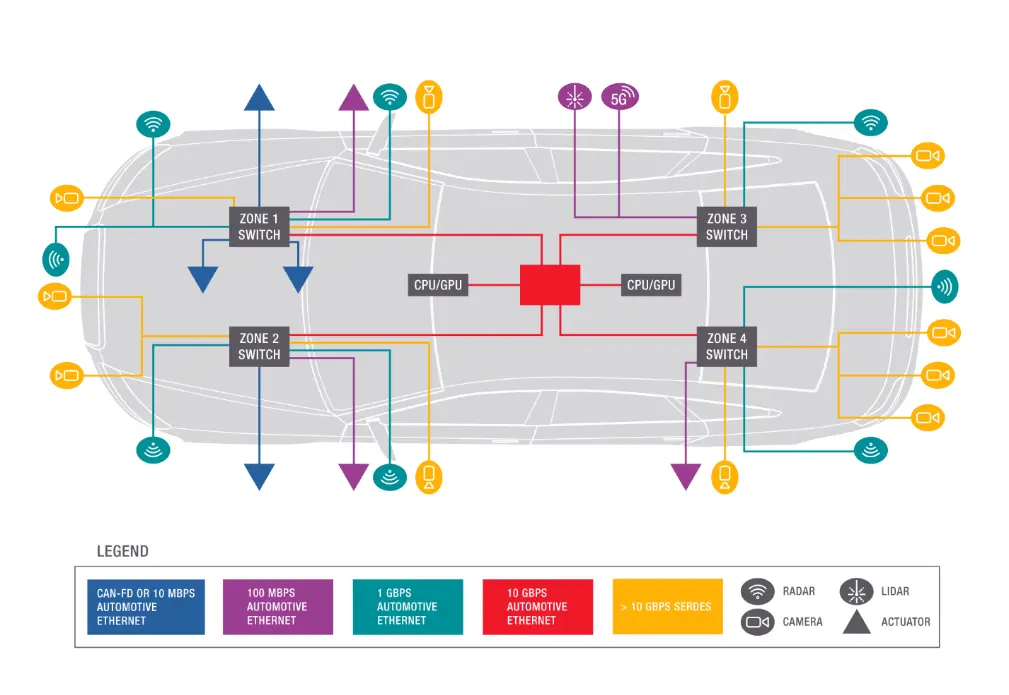
As products add more cameras—often placed far from the main processor—connectivity becomes a product architecture decision, not just a hardware detail.
Automotive systems, robots, industrial machines, and wearables all face the same question:
How do we reliably connect remote cameras without redesigning the entire platform?
The answer is SerDes. But choosing which SerDes technology—GMSL, FPD-Link, or MIPI A-PHY—has long-term implications for cost, risk, and roadmap flexibility.
Why Traditional MIPI Is Not Enough
MIPI CSI-2 and DSI were designed for short, internal connections—like phone cameras or laptop displays that sit just centimeters from the processor.
They work extremely well inside a device. They struggle once the camera moves outside the board.
Limitations of Traditional MIPI
- Very short reach (typically <20–30 cm)
- Sensitive to electrical noise
- Fragile connectors and cables
- Poor fit for multi-camera or harsh environments
For products with remote cameras, these limitations quickly become blockers.
What SerDes Changes
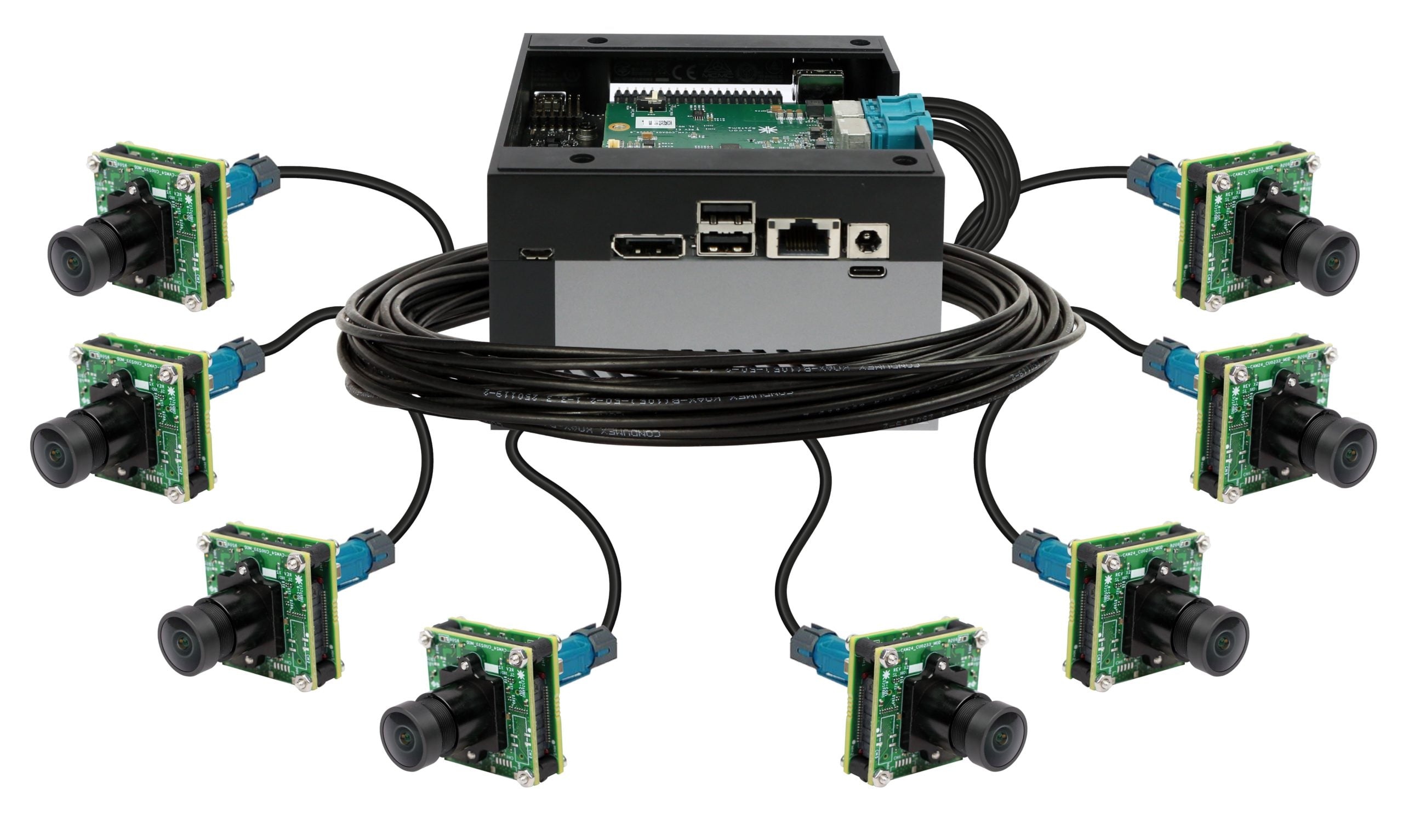 Traditional MIPI is limited to short board-level connections, while SerDes enables long-reach, robust camera links.
SerDes (Serializer / Deserializer) converts short-range MIPI signals into a long-reach, robust link, then converts them back near the processor.
From a product perspective, SerDes enables:
- Cable lengths of meters, not centimeters
- Single-cable designs (data + power + control)
- Stable performance in noisy environments
- Scalable multi-camera systems
- Minimal impact on SoC software
Traditional MIPI is a board-level interface.
SerDes turns it into a system-level architecture.
Which SerDes?
Once a team accepts that native MIPI isn’t sufficient for remote cameras, the decision shifts from whether to use SerDes to which SerDes strategy to adopt.
This is where GMSL, FPD-Link, and MIPI A-PHY diverge.
- GMSL and FPD-Link extend MIPI using proprietary, mature ecosystems focused on speed and reliability.
- MIPI A-PHY aims to standardize long-reach connectivity and reduce vendor lock-in over a product’s lifetime.
All three solve the same technical problem—but they make very different business and roadmap tradeoffs.
GMSL (Gigabit Multimedia Serial Link)
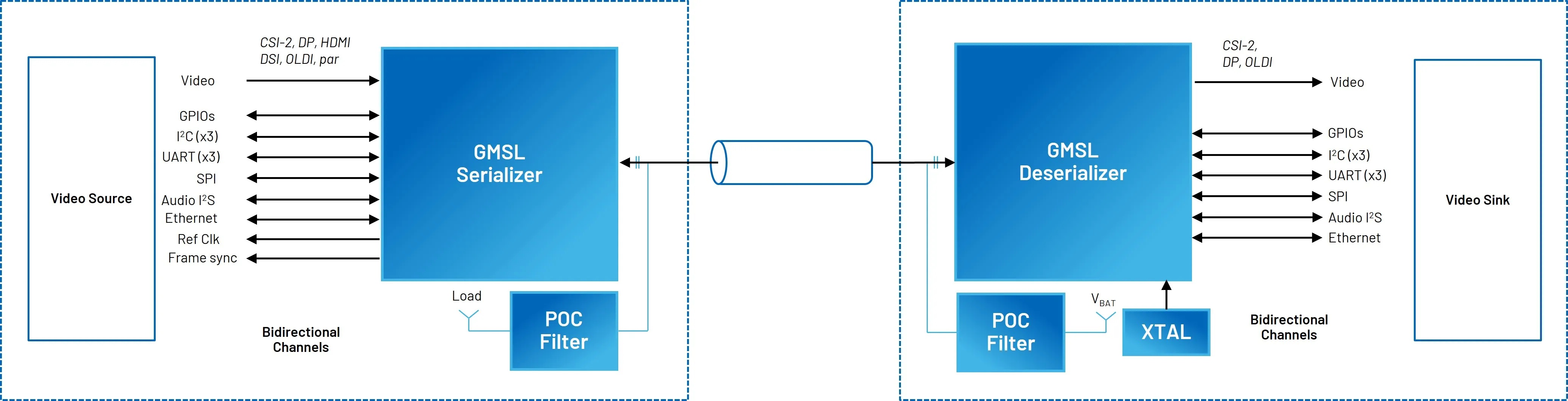 Typical GMSL setup with a remote camera module connected to a central processor over a single cable.
Owned by: Analog Devices (formerly Maxim)
What it is:
A proprietary SerDes technology purpose-built for cameras and high-speed sensor data.
Why product teams choose it
- Deployed in millions of vehicles
- Very low latency
- Transparent MIPI CSI-2 integration
- Power, data, and control over one cable
Tradeoffs
- Strong vendor lock-in
- Limited interoperability
- Premium BOM cost
Best fit
Products that prioritize low risk and fast time-to-market.
FPD-Link
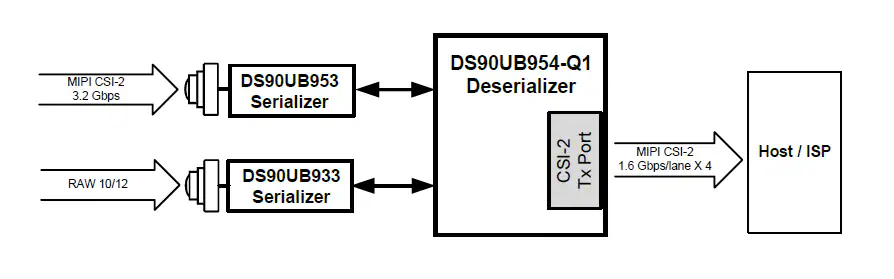 FPD-Link architecture commonly used in automotive and industrial camera systems.
Owned by: Texas Instruments
What it is:
A long-standing SerDes family originally developed for displays, now widely used for cameras.
Why product teams choose it
- Automotive-proven and highly reliable
- Strong multi-camera support
- Seamless MIPI CSI-2 compatibility
- Tight integration with TI platforms
Tradeoffs
- Proprietary ecosystem
- Similar lock-in profile to GMSL
- Comparable cost structure
Best fit
Products already aligned with TI supply chains or platforms.
MIPI A-PHY
 MIPI A-PHY standardizes long-reach camera connectivity for future automotive platforms.
Owned by: MIPI Alliance (open standard)
What it is:
The first standardized long-reach physical layer designed specifically for automotive and industrial camera systems.
Why it exists
- Reduce fragmentation
- Enable multi-vendor interoperability
- Support long product lifecycles
- Meet future safety requirements
Advantages
- Open standard
- Designed for functional safety
- Long-term roadmap flexibility
Current limitations
- Ecosystem still emerging
- Fewer production deployments today
- Slightly higher integration effort
Best fit
Products with long lifecycles and platform reuse goals.
Side-by-Side Comparison (PM View)
| Criteria | GMSL | FPD-Link | MIPI A-PHY |
|---|---|---|---|
| Ownership | ADI (Proprietary) | TI (Proprietary) | Open Standard |
| Market maturity | Very high | Very high | Emerging |
| Vendor lock-in | High | High | Low |
| Latency | Ultra-low | Ultra-low | Ultra-low |
| SoC integration | Very easy | Very easy | Easy (growing) |
| Automotive adoption | Widespread | Widespread | Growing |
| Long-term flexibility | Limited | Limited | High |
How Product Teams Should Decide
Choose GMSL or FPD-Link if:
- Time-to-market is critical
- You need proven reliability today
- Vendor lock-in is acceptable
- Product lifecycle is 3–7 years
Choose MIPI A-PHY if:
- You’re building a long-lived platform
- Interoperability matters
- You want supplier flexibility
- Future automotive safety requirements are a priority
Final
GMSL and FPD-Link win on maturity and speed.
MIPI A-PHY wins on openness and future-proofing.